Advanced technologies to revolutionize Canada’s manufacturing sector
Design Engineering
By Sean Tarry
June 11, 2025
NGen CEO Jayson Myers explains how innovative manufacturing solutions are poised to escalate development and drive economic growth in the country
June 12, 2025 – There’s no doubting that the current economic climes that we’re all living through are challenging, to say the least, posing individuals and businesses everywhere with difficult decisions to make in order to maintain status quo. Largely being defined by equal parts uncertainty and unpredictability, and enveloped by an unprecedented level of worldwide confusion, current economic volatility is wreaking havoc on trade strategy and growth.
Instability equals opportunity
Brought about by an American administration and its President’s erratic whims that seem intent on achieving global destabilization and vulnerability, development and progress in all corners of the world are being threatened and curtailed. Despite these disruptions, however, or perhaps in spite of them, according to Jayson Myers, Chief Executive Officer at NGen, Canada has the opportunity to forge ahead with its growth ambitions through the use and continued development of advanced manufacturing technologies.
“First of all, I think the economic priorities that the government has defined are spot on,” he says. “But to address these priorities properly, we need to do a better job at converting all of these great innovation assets that we’ve developed into real value. In the case of advanced manufacturing, these technologies present the potential to help manufacturing companies generate economic growth through greater output and improved quality, while creating meaningful jobs within the community and contributing to sustained economic growth for the country.”
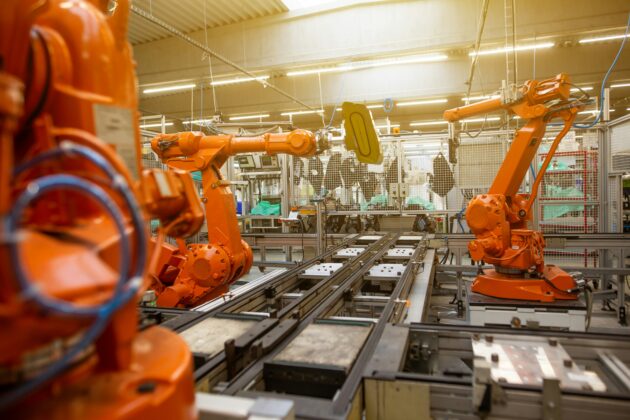
Simon Kadula: Multi axis robotic arms on advanced manufacturing production line. Image courtesy of NGen.
Leveraging technological capabilities
Myers references the government’s priorities as outlined within King Charles’ Speech from the Throne that he delivered during his visit to Ottawa at the end of May. Accelerating home building, ramping up defense procurement and building more resilient value chains throughout the country were among the focuses shared. And they are all ends that Myers says can be met by leveraging Canada’s array of advanced manufacturing technologies. In fact, he suggests that the government’s goals are likely unattainable without their use.
“Canada is in desperate need of a rebuild of its defence infrastructure,” he asserts. “The healthcare sector is in constant need of advancement and technological support. And we’re also faced with the very real and immediate need for the development of affordable housing. These are all critical issues that the Canadian government needs to deal with, all of them requiring new products, solutions and technologies. It’s not business as usual here any longer. And as part of this urgency, we need to really begin leveraging these great technological capabilities that we have access to in the country.”
Integration challenges
Myers goes on to explain that just about every industry and sector can stand to benefit from the use of advanced technologies, from industrial applications of AI to the use of advanced materials and additive technologies. In fact, he believes that their use can serve to revive the Canadian economy and begin to rebuild capacity within the country. However, he recognizes a couple barriers to the mass adoption and effective application of these innovations.
“The integration of these types of advanced technologies can be difficult for some businesses to navigate,” he says. “And more to the point, it’s about integrating these technologies with other technologies to arrive at the solution you need right now. It’s about combining the technologies and integrating them to develop a customized solution to suit your needs. Then, the computing and data requirements to sustain the technology needs to be considered, as well as the maintenance that will be needed, and what ROI will be needed in order to make the investment sustainable over the long term.”
New skills required
In addition to the complexities of integration, the adoption and use of the latest state-of-the-art advanced manufacturing technologies also requires a rethink of the skills and aptitudes that are needed to see their potential through to fruition. In fact, according to Myers, the advent of advanced technologies is forcing an entire philosophical shift in the way businesses conduct themselves and view their path forward.
“Advanced manufacturing technologies require companies to do business very differently and think differently about the skills and the people that they need to get the most out of them,” he says. “They are incredibly transformative technologies offering a range of opportunities to find efficiencies, reduce cost and speed up time to market. But to harness that transformative potential, businesses will really need people who are able to manage the complexities of the technology, those who excel at manufacturing management, and those who understand how technologies are being used and are capable of implementing AI into their processes and operations.”
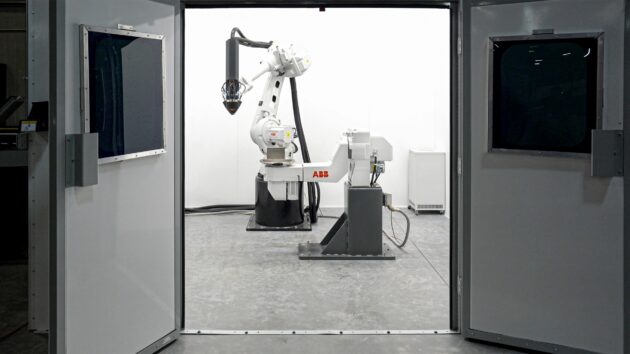
Hermeus: Mutli axis robotic arm for mixed use applications. Image courtesy of NGen..
The role of engineers
When it comes to design engineers, machine builders and OEMs and their roles in the advanced manufacturing revolution, Myers suggests that they will be critical and required to innovate in order to contribute toward the realization of the government’s vision. In fact, Myers says that in light of the current economic instability throughout the country and around the world, the chance for some companies to capitalize on the situation may be on offer.
“One thing that’s certain is the fact that as a result of the development of these new technologies, in combination with the economic crisis that we’re in, there will be all sorts of new opportunities for companies that can position themselves to take advantage,” he explains. “There are opportunities in particular for companies that can help their customers understand how their technological solutions can benefit them. There are also opportunities for engineering companies, technology solutions providers, manufacturers and machine tool shops to go into new product lines to displace US imports into Canada or to go international. And there’s a lot of opportunity around creating something different in order to stand out from competitors. This is where design engineering becomes really important.”
Facilitating innovation
Myers explains that much of the benefits around advanced technologies are around the ways in which they can benefit design engineers by way of improved processes, customization options and throughput, in addition to enhanced efficiencies throughout. The result, he says, is innovation around product design and a facilitated time to testing and market, all serving to remind companies of the importance of design and elevate the roles engineers play in the manufacturing process.
“Businesses are beginning to remember just how important excellent design is to the overall manufacturing process,” he asserts. “It’s the foundation of the value that’s being offered to the end user through a deep understanding not only of the product itself, but the way it’s going to be tooled, its functionality, the way it’s going to be delivered and how customers are going to use and manage the product. These are all critically important aspects of the product journey that engineers are responsible for and are only going to grow in importance as we move forward.”
Source: https://www.design-engineering.com/advanced-technologies-to-revolutionize-canadas-manufacturing-sector-1004046192/